May 21, 2019

Trips, Journeys, Voyages - More from Cork


I've been back from Ireland for almost a month. There have been so many welcomes back--buying coneflowers and basil to plant on the balcony, cooking spicy dinners, a few long phone conversations, petting the kitty x 10, sifting through my books on their shelves, watching the American University MFA students give their graduating readings, even a bottle of Maker's Mark (cask strength!) as an unexpected gesture of Southern-Foodways-inspired generosity. There is good to being home. 


Yet Ireland is still echoing through my head; so many shades of gray, blue, and green.


Venturing to the seashore in Garyvoe, and up to the edge of the cliff all in Ballycotton, with my student on an overcast day--before we took shelter at the Jameson's distillery.


The countryside is dotted by yellow gorse, beautiful but thorny (and invasive). Another student showed me that the crushed flowers smell uncannily like coconut.


When my parents came to visit, we braved the roads in their rented car to Clonakilty and beyond to see the stones of Drombeg. We pulled up to a silent, misty field.


A small bit of signage helped us understand what we were seeing: the circle of seventeen stones oriented toward the midwinter solstice's setting sun, with a center where an urn with cremated bones had been recovered, dated to somewhere between 153 BC and 127 AD. Nearby, the remains of two small huts, plus a hearth and trough where water would have been heated by dropping in stones heated by fire. 


A friend drove me to Kinsale by way of several small towns, including a stop at the ruins of Timoleague Abbey. The weather was comically rainy--great gusts pushing us as we traipsed through the soaked courtyards. 


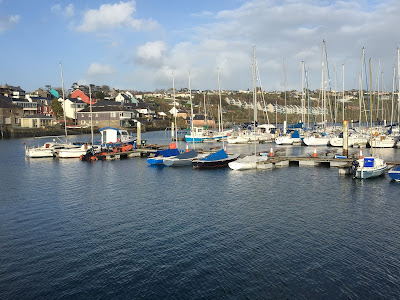
By the time we got to Kinsale, the weather (and the water) was a crystalline blue. We circled the edges of the Charles Fort.


A few weeks later, my husband and I caught the bus to Kinsale, going into the fort for an hour to explore before venturing further out to the water's edge.


From the Scilly Walk back to downtown, you can see the remains of the older James Fort--occupied by Spanish forces during the 1601 siege--on the far shore. 


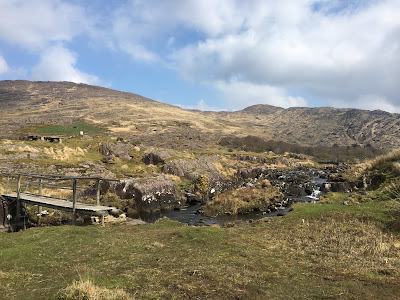
One of my students took us to her family's place by the shore, just outside the town of Castletownbere in the Beara Peninsula. The forecast had predicted two straight days of rain. The fates were kind and the weather cold, but clear. I come from a family of seashell-hunters and it felt right that for the first time in Ireland, I found them here.


The schedule was simply: stop for whatever beckons before the sun sets. That began with a walk along sea cliffs. My student knew the right gate to open.


We made what should have been a quick stop to see the (purported) shrine to the children of Lir, only to be gently waylaid by a pack of horses that had gotten loose.


Ireland's only cable car runs to Dursey Island. The door is secured with a latch. Emergency supplies consist of a two-way radio and a bottle of holy water.


Making our way back for the night, we saw a sign for a ring fort--a place even my student had not yet visited--and decided to check it out. Wherever there's a green ladder, you have permission to go. Just don't bother the sheep.


A new day, a new gate to open--this time to see a stone with an ogham inscription, a primitive form of Irish writing. 


Our host wanted to show us Gleninchaquin lake and the Uragh stone circle, which crossed us into County Kerry. We got to the stone circle and found it overtaken by sun-lazy sheep. Slowly, surely, we negotiated with the locals for a closer look.


A week later, when another poet offered to take us anywhere we wanted to go by car, I said: "I'd like to see castles." And castles he did provide: three in one day, with a bonus spotting of a sheela-na-gig when we stopped off in the walled town of Fethard. The enclosure of Fethard probably dates to the 14th century. These female figures, with their exaggerated sexuality, date from well before that--appropriated and re-mounted into the walls. In 1990, when one disappeared from the town, the tabloid headline read "Rude Nude Stolen."


Kilkenny had the castle I'd heard about, and it probably pained my Tipperary-born host to be so set on seeing it. He patiently endured my misguided pursuits of cream ale on draft and hurling tchotchkes, steering me instead towards a a perfectly good tavern whose owner, Alice Kyteker, was convicted of witchcraft  in 1324 after her husbands kept dying. Fortunately, she escaped to England before she could be burned.


The Cahir castle was the best, the surprise of the day--a beautifully preserved example of 13th-15th century defensive design. The rooms inside were stark, with stairs of varying heights designed to trip up invaders. 


The portcullis is the only one in Ireland still fully operational. You've probably seen it come snapping down in a movie. A few days earlier, shooting had wrapped on scenes for The Green Knight, a retelling of the Sir Gawain myth due out in 2020. 


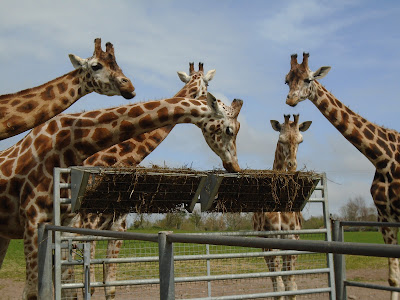
We knew we wanted to try taking the train, and Fota Wildlife Park was an easy twenty-minute ride from the city centre. I was stunned by the extent to which the animals can roam free, and the size and the healthiness of their populations.


From there, we went on to Cobh. Don't bother, a few told us, but there's something special about this hilly, slightly dingy port city that has been a jumping-off point for so much history.  We had a pint at Connie Doolan's and heard the story of how the owner had acquired the bar, after the previous owner had won it in a contest run by Guinness. I found myself in the seat frequented by "mailbag baby" Millvina Dean, who for years had been the last living survivor of the sinking of the Titanic.


My student suggested one last road trip, on the heels of our last mentoring session at Alchemy Coffee. Gougane Barra sounded modest enough--a church in a valley--but the actual site of where Saint Finnbarr took shelter, before going on to become the first Bishop of Cork, was unexpectedly moving. This lake marks the source of the river Lee. 


We took one of the forest walks. Except it turned out to not be an official "forest walk" at all, but straight-up hike through private farmland--the part where we climbed a ladder should have been our tip-off. Soon the church was just a dot far below.


My first poetry teacher, Rose MacMurray, titled her book Trips, Journeys, Voyages. These are snapshots from the trips, a day or two at a time. The journey took me from D.C. to Cork and back, and it's a journey that (with any grace of luck) I'll be making again. The last time I felt this strongly about a place was Mississippi, and I wouldn't mind if they both turn out to be lifelong affiliations. The voyage is a larger one, of trying to figure out the writer I can be in this world. No map, but with the good fortune of the wind at my back, and these memories still fresh in my heart. 

April 30, 2019

Save the .4%! (Or: The Autonomy of the DC Commission on the Arts and Humanities Is Under Attack. Artist Grants Are Being Targeted. Here's What You Need to Know.)

ANOTHER UPDATE:

"Mayor Muriel Bowser Wants Big Changes for the City's Arts Commission"

And that has many people in the arts community on edge.

Washington City Paper's comprehensive overview of how we've gotten here, with many thanks to Matt Cohen and Kriston Capps for their reporting.

UPDATE:

"Mendelson Moves to Block Mayor’s Restructuring of the City’s Arts Commission"

The Council chairman's pointed budget recommendations come after a public outcry from the arts community.

Read the whole story here, via CityPaper.

...Apologies if I contributed to any confusion by citing a .4% figure versus .3%; that was a point of accidental misinformation at the Eaton Hotel meeting. Thanks to everyone who helped get the word out and advocated with their councilmembers!

# 

Chairman Phil Mendelson
DC Council of the District of Columbia


Dear Chairman Mendelson,

I am writing to express grave concern over the status of arts funding in the District of Columbia in the proposed Fiscal Year 2020 budget put forward by Mayor Bowser’s office and now being considered by the Council. 

The specifics of the Commission on the Arts and Humanities budget table (BX0) are nested within“2020 Economic Development and Regulation.” This structure recognizes the symbiotic relationship between the arts and the general economy. Robust arts activity is a key contributor to our city’s finances. But that revenue will continue only if artists are given funding to create a vibrant, inclusive, multi-disciplinary scene that attracts audiences. Support for arts is crucial to the preeminence of Washington, D.C., in America’s cultural landscape.  

For the Fiscal Year 2019, as a result of focused advocacy and initiative, Washington, D.C., dedicated .4% of its sales tax revenue to funding for the arts. This allocation was an important and logical gesture recognizing that local arts—galleries and exhibitions, dance, theater, and music performances, literary festivals, and other events—are a principle draw for retail activity in terms of tickets, merchandise, and tandem items such as food and drink. The Mayor’s proposal eliminates that hard-earned allocation, proposing a set disbursement instead. 

In the short term, the amounts might be comparable, but in the long term this severs an organic alignment between commercial growth and arts funding. The consequence is painfully ironic for artists who are part of a neighborhood that picks up business as a “hotspot” for arts tourism, due to their labors, only to be priced out of residency. When funding amounts stay static while the costs of living continue to rise precipitously, practicing artists are forced out of the city. Restoring the dedicated sales tax funding is both a practical and proportionate decision.

Another point of concern is the “DC Cultural Plan,” which includes an “Innovation and Entrepreneurship Loan Fund.” Individual artists who might have previously received grants will, instead, be directed toward loans. There is no disclosure of what public or private institutions will offer these loans, or their terms. This proposal is grossly inappropriate in its understanding of an artist’s income model, and entrenches debt upon those likely already struggling with the debt of higher education and any attempt to own local housing or studio space. 

The manner in which these and other changes have been put forward, without dialogue with those responsible for DCCAH’s daily functions, indicates what seems to be a larger goal to undermine the Commission’s authority and subvert its existing (and legislatively mandated) independence. Other symptoms have been the reassignment of the poet laureate position from DCCAH overview to the Mayor’s Office of Talent and Appointments, and the attempt to attach a morality clause to grant paperwork without Commissioners’ knowledge or approval.

The justification for some of these designs has been the practices of other cities. But Washington, D.C., stands alone as a city, a de facto state, which doubles as the seat of national governance. Our resident artists and organizations are in a unique position of engaging local, metropolitan, and federal audiences simultaneously. The Commission was founded soon after the National Endowment for the Arts, another beloved institution under recent attack, and has had fifty years of effective action. The autonomy of DCCAH should be celebrated, not corroded. 

My confidence in the Commission on the Arts and Humanities is informed by firsthand experience with their capable staff. As a resident since 2002, I am a four-time recipient of individual artist grants and a two-time Larry Neal Writers’ Award winner. I have volunteered my time as a panelist. I have attended commission meetings where I spoke during the public comment portion, and I will attend more. Experienced arts administrators and voices of reason among the DCCAH Commissioners are calling for help and transparency. Please listen to them. 

Chairman Mendelson, I believe in your commitment to the city. I trust that you will take these concerns seriously. I am copying this letter to Ward 6 Councilmember Charles Allen, who represents my Southwest neighborhood, as well as At-Large Councilmember Elissa Silverman, and I will circulate the text publicly. These issues are time-sensitive and urgent. Every artist and arts organization in Washington, DC., and all those who reap the benefits of our arts community, will be negatively impacted if the budget advances as proposed.  

Thank you for your consideration, and I look forward to hearing from you. 

Sincerely,
Sandra Beasley

April 01, 2019

Teaching (& Festival-ing!) in Cork


Strange to navigate the busy waters of the Cork International Poetry Festival, and then the very next week--from a distance, via social media--watch writers navigate the even busier waters of the AWP Conference in Portland, Oregon. I managed to photograph every reader I saw in the Cork Arts Theater, except for closing night when my phone died. (Note that this happened mid-email. So I spent an agonizing twenty minutes wondering if I was standing up Kim Addonizio. Luckily, she got the message and made her way to Cask to meet up for dinner.) The downside of the phone dying is that I can't show you Kim's awesome shoes, or the sweet interplay between Billy Collins and Leanne O'Sullivan, a rising star of Irish poetry who had received the Farmgate Café National Poetry Award earlier in the week. The upside is that I was able to relax and fully inhabit those moments. 

The festival was an extraordinary event overall, and I particularly praise the organizing efforts of Patrick Cotter, Director of the Munster Literature Centre, and MLC administrator James O'Leary. One of the notable features is the commitment to cross-cultural exchange, with several multi-lingual readings. The pleasure of hearing Polish poet Tomasz Różycki (right) was heightened by knowing that a stateside friend, Mira Rosenthal, had done the artful translations of his sonnets. Copies of Colonies sold out almost immediately, but I snagged one and had him sign it; I'm hoping to have Mira sign it, too, at some future AWP. 

Festival photos aren't the most exciting material; they take place in a monotonous setting. I take them to lock in the remembered experience. But I knew I wanted to post a few photos, and that includes snapshots of my co-reader Kim Moore (left)--what terrific company of smart, funny, feminist poems, including the "All the Men I Never Married" series--and of Shangyang Fang (top), winner of the Southword Journal's Gregory O'Donoghue International Poetry Competition, whose work showed daring and exuberance in its intimacies of image, with intriguing choices of when to dart like a diving bird and when to meander along the stream of consciousness. Another favorite was Sasha Dugdale, who read an astonishing title poem from her collection Joy that channels the voice of Catherine Blake (William's wife and collaborator on his printmaking); I bought the book and devoured the whole thing later that night. I was thrilled to see students from both University College Cork and MLC mentees present at the Cork Public Library, which is also where Cumbrian poet Katie Hale read from Assembly Instruction, winner of this year's Fool for Poetry Chapbook Competition. Her "Teaching Grammar in a Poetry Lesson" is an instantly satisfying ars poetica, a bit like Billy Collins' "Introduction to Poetry." But unlike the Collins poem it ultimately yields to celebrating the creative instincts skills of the students, rather than disdaining their attachment to meaning. An immense, endearing compassion pervades Hale's work. 

I took a little downtime this past weekend to update my teaching files. Since I'm not working toward some future tenure application, it's important to pause periodically and do my own self-archiving of the lessons I've created, including fine-tuning of handouts and syllabi. My commitments in Cork include a graduate-level workshop at University College Cork, where we used the sonnet as a recurring building block of formal engagement; two community menteeships with accomplished students, tailored to their needs on such topics as sequence-building and manuscript organization; and a standalone meeting with the women's group of the Cork Migrant Centre, housed at Nano Nagle Place, where we discussed poems of origin and heritage. As part of the festival time, I offered a four-day seminar class on "Bringing the World to the Poem" that ended up filling to capacity.  

As has happened at every turn in Ireland, I was delighted by the curiosity and sophistication brought to the close readings. Each day I turned up with eight to ten possible poems, then went with the five that felt right for the pacing and interests of the group. I thought it'd be fun to share here--links to texts where available--along with photos of the prompts I offered. (If you're reading this with a screen reader and want access, email me at earthlink.net and I'll transcribe.) They're organized by theme, which is how we progressed day by day. One of the decisions I had to make was whether to try and feature Irish poets, but I decided to play to my strengths of familiarity and shared culture. As I told the group, they didn't need an American poet barging in to teach them about Seamus Heaney. 

ANIMALS

Mark Doty - "Golden Retrievals"
Ada Limón - "How to Triumph Like a Girl"
Jamaal May - "There Are Birds Here"
Lucia Perillo - "Shrike Tree"
Dan Chiasson - "The Elephant"


FOOD

Elton Glaser - "Shucking"
Henry Taylor - "Artichoke"
Wisława Szymborska - "The Onion"
Kevin Young - "Ode to Pork"
Naomi Shihab Nye - "My Uncle's Favorite Coffee Shop"


TRAVEL 

Richard Blanco - "Looking for the Gulf Motel" 
Cyrus Cassells - "Return to Florence"
Beth Ann Fennelly - "Souvenir"
Sally Wen Mao - "Riding Alone for Thousands of Miles" 
Megan Fernandes - "Amsterdam" 


SCIENCE

Camille T. Dungy - "The Blue"
Kimiko Hahn - "Maude"
Jane Hirshfield - "For the Lobaria, Usnea, Witches Hair, Map Lichen, Beard Lichen, Ground Lichen, Shield Lichen"
A. Van Jordan - "Einstein Defining Special Relativity"
Alberto Ríos - "Some Extensions on the Sovereignty of Science"


Turns out that in addition to wrapping up finals grading at UCC and working with my community mentees, I have one more unexpected teaching opportunity on the docket. As part of the daily prep and handout-making for the festival workshop, I made friends with the good folks at Mouse Internet Cafe. So when I found out that an instructor had cancelled on them for an event scheduled as part of the Cork Lifelong Learning Festival, I offered to step in. If you happen to be in Cork on Monday, April 8, come hang out with us at 7 PM (location on Barracks Street near the Southgate Bridge). We'll be discussing "Three Poems for People Who Really Dislike Poetry."