Image credit: "Why We Write," by Grant Snider
***
Dear Graduating MFA Students,
Pssst. You don't need to go into academia.
Has anyone said that to you yet? Because it is so important to receive that message.
You.
Do. Not. Need.
To.
Go.
Into.
Academia.
But I love teaching!
Then teach!
I understand feeling that teaching is a vocation that you're called to, enjoying the community that it provides, and wanting to incorporate it into your path of professional experience. But you can do those things without making teaching with being your primary source of income and (ahem, America) health care. For decades, every major city in the United States has had at least one if not multiple community-led spaces for workshopping poetry, fiction, and nonfiction. During the height of the COVID-19 pandemic (not that the pandemic is over, nota bene), these organizations had to adapt to moving all their learning opportunities online. Most of these organizations are keeping those channels open, understanding the ways that online learning can increase equity and access--which means that even if you don't end up living in a major city, you can still offer a class through that hub.
Will you make much money? No. Best case scenario is a 50/50 split of proceeds with the hosting institution. But you'll teach classes on topics in creative writing that you truly care about, versus composition, and you won't be saddled with grading or advising (a responsibility that often falls back on beloved teachers, when those assigned to do it fail to do it). You might meet adult students who choose to take your classes again and again, and become a meaningful part of your audience (your "platform") for when you get books out into the world.
Just a few of the places that you might pitch regarding workshop proposals:
Note, what you'll want to do first is write a short, polite note to someone on staff, requesting to be added to the email list that calls for pitches. They probably reach out to their existing pool of instructors 1-4 times a year to gauge interest, with set deadlines for submitting ideas. Be prepared to give a brief (one paragraph) introduction to your education and background, including any journal pub credits, and a couple of sample courses (at the very least, indicate the genres you did your thesis in). Do play up any local connections, even if you're hoping to teach remotely. For remote teaching, clarify whether you're drawn to synchronous learning (using meeting platforms such a Zoom) or asynchronous (in which you build the course content entirely in written form, online, and post feedback, versus orchestrating the live workshop experience). Plan a class that can be excused successfully in 4-8 weeks, OR one standalone session (typically informational or generative, perhaps focusing on a single shared text, versus something that is discussion- and feedback-based).
If you find your initial queries to organizations such as these aren't getting traction, or if you ge the chance to offer a class but it fails to "make" the minimum numbers, don't despair. You may you need a little more time to develop your record of publication. Sometimes these organizations can create enrollment draw based on the topic alone; other times they are looking for the added value of the instructor's reputation.
Consider cross-referencing your passion for writing with another cause you feel passionate about--such as working with the LGBTQIA+ community; people who have experienced domestic abuse; outreach to unhoused or incarcerated populations; mission-driven organizing (environmental or social justice); or working with specific age groups, such as middle-grade children or senior citizens. Look for organizations whose work is in those sectors, versus being squarely in the "literary writing and publishing" space, and ask about opportunities to bring a creative workshop component to any existing outreach programs. Be prepared to volunteer your services at first, and keep your time commitment proportionate to that (1-6 sessions, max), but trust that it is legitimate and useful experience to build a CV.
Since these organizations tend to have a firmer and specific geographic radius of reach, I can't offer a general guide. But here are a handful of exemplar DC-area organizations that I know to have utilized volunteer service to lead creative writing or storytelling workshops in the past:
Don't forget to consider querying local museums, libraries, and (if a comfortable fit) churches or centers for faith-based gathering as well.
***
Okay, okay. So maybe I don't have to go into academia to satisfy my love of teaching. What do I do instead to pay the bills?
If you think you don't have options beyond academia, please understand, that's not evidence of a limited capacity or skill-set on your part. That's an institutional failure to think outside the models at hand; meaning, most of your mentors are they themselves in academia, and have been for at least 5-10 years, if not their entire professional lives. Remember, you came to an MFA program because you wanted to write and publish books, right? Choose the job that sustains that goal.
Here are three ways that non-academic jobs may actually be better suited to nourishing your writing-career aspirations:
-The job has clearly defined hours from which you can can clock out, versus the constant "I should be prepping..." The emotional stakes are typically lower; yes, you may stress to meet a proofing deadline or make a big presentation, but you won't have the well-being of students on your mind. At-office jobs may provide infrastructure resources (e.g., printing, internet) that you can occasionally divert towards your own projects. Academia loves to talk about funding attendance to conferences, but it's rarely enough to offset the full cost of a trip, whereas if you travel for business outside academia they will take responsibility for the full docket of expenses (and you still get to do a little sightseeing on the side).
-Vacation weeks can be taken year-round in non-academic jobs whereas, in academia, your "time off" is attached to very particular and inflexible seasonal windows. Those are the same seasonal windows that every other academic applying to artist colonies and residencies are requesting, which makes those periods hyper-competitive. If you get an opportunity whose duration exceeds your available vacation days, and you've been working at the company for more than a year, consider presenting your notification of acceptance with a thoughtful request for additional days as unpaid leave; this may be a viable option, especially if you're willing to be available for emergency contact if needed.
-You're organically doing "research" outside the realm of literature, which can provide the grist of settings and subjects for your manuscripts. Building a creative landscape on the pedagogy of learning is challenging to do in interesting ways; drawing on the lives of your students, when building characters, poses deep ethical concerns. In contrast, there's a bold tradition of situating stories in non-academic labor landscapes and, even if your office setting isn't dynamic, you'll benefit from the variety of life experience you pick up on in conversation with work colleagues. Any job that expands your vocabulary--whether by introducing the dictions of science, tech, medicine, law, even economics--is a net gain.
If you're reading this as a graduate student local to DC, I'd like to amplify: please consider staying! This area is unusually deep and varied in terms of these kinds of non-academic opportunities for employment in writing and editing. For example: federal and city government and funded-initiative offices (i.e., Golden Triangle or SWBid), advocacy non-profits, science and tech organizations with national membership and DC headquarters, plus straightforward media organizations such as The Washington Post, NPR, National Geographic Society, and The Atlantic.
How do I find these jobs in writing and editing?
As a starting place, try Indeed and Idealist, searching using key terms such as "writer" and "editor." If a job asks for 1-2 years of professional experience and you didn't work during your MFA years, don't be afraid to apply anyway. Those kinds of stipulations are just meant to ward off completely unqualified candidates; if you're a match in other ways, and you have a good interview, they'll trust that your learning curve will be sufficient for you to catch up. (If they're requesting 3-5 years, don't apply unless you have legitimate professional experience you can cite, though you can be liberal in teasing out "writing and editing" from a previous job that was not explicitly labeled as such, such as grant development or paralegal work.)
What do I need to be prepared to apply for these jobs?
-A resume of one page that leads with professional experience, then education history, then other skills such as languages and office software proficiencies. You can add characterizing language under the professional experience, typically 2-3 bullet points of descriptive language. Emphasize strong and active verbs, yet drop the "I" whenever possible; may read as a fragment, but that's okay. Play up any significant scales in terms of budget or populations served. (That said, keep your multi-page CV up to date! They are so, so hard to create later if you do come back to academia, especially in terms of tracking real-time readings and journal publications. Trust me, this was my hard-earned lesson.)
-Be familiar with the likely format of any "tryout." In terms of writing tests, they probably don't want to see that ten-page essay with MLA citations that you wrote. They probably want to see a 500-1200 word sample press release or blog post that reflects the vocabulary of the organization, with straightforward syntax and language that is musical but not self-indulgent. Hold off on the metaphors and similes for now. If you receive a proofing test, anticipate a letter to shareholders, a white paper (a particular type of in-depth report associated with non-profits), or a case study. Here's a couple of round-ups of exemplar case studies:
...You'll be expected to provide both objective corrections, fixing typos and grammar, as well as subjective style considerations around syntax, formatting, and diction.
-References (but not letters, thankfully). If your references are former professors, give them a heads-up so they know to praise the appropriate qualities. If you did something outside the classroom that is relevant--such as working with the school-hosted literary journal--make sure they know your scope of experience so that they don't default to discussing "scholarship" and "creative talent." Those great qualities may be be counter-productive to emphasize here; you don't want the employer to be scared off by wondering if you'll stay.
Wait. Back to that editing test; I don't have the chops! What am I going to do?
Well, you gotta learn if you want to make money as a professional writer and editor. There's no way around that. I'm not saying that your creative work needs to hew to the rules of Western colonialist culture; there's all kinds of good arguments contrary to that kind of absolutism. But there are few downsides to having a broad array of tools at your disposal, so think of this as a tool you're taking the time to acquire. (Also, this was going to come up if you stayed on the American academic track, anyway.) Fortunately, there are a couple of reasonably priced resources for online learning of professional writing, field-specific copywriting, and editing. Approach these classes the same way you'd take a chance on a Duolingo course:
If you want a litmus test of copyediting skills, the New York Times did a series of fun, fast, and free "Copy Edit This!" quizzes spanning 2016-2019, seventeen of them in all.*
(*Now that you know the title convention, you can search out the ones in-between.)
The good news is, you probably have all kinds of intuitive skills that you regularly apply--and take for granted. They just need a little sharpening.
MFA students, I am rooting for you. I believe that a 2- or 3-year program, whether residential or low-res, can provide a real and specific good of sowing the seeds of a creative writing pursuit. Anyone who says the MFA is a dying degree, due to the ascent of the PhD in creative writing, is myopically focused on the belief that graduate degrees in creative writing should lead to a full-time teaching job. There are other paths! Paths that are open and waiting and (dare I say it) may even be a lot more humane and nourishing to you as a writer.
Go get 'em.
***
In other news: I'm here, waving from DC, as I do from time to time. Won a prize! (Yay, seriously yay.) Was a finalist for another prize. Working on a proposal for the next book. Wrote a thing for American Poets on T.S. Eliot's The Waste Land. The paperback edition of Made to Explode will be out in December. Come March 2023, I'm going to be part of an AWP panel in Seattle that is getting the support of livestream, captioning, and ASL interpretation, which makes me very happy. I am both teaching at American University, and not-teaching (e.g., freelancing) with a pretty great company called the Maestro Group, a company that has ties to my high school, and which invites me to write funky blog posts for them such as this series:
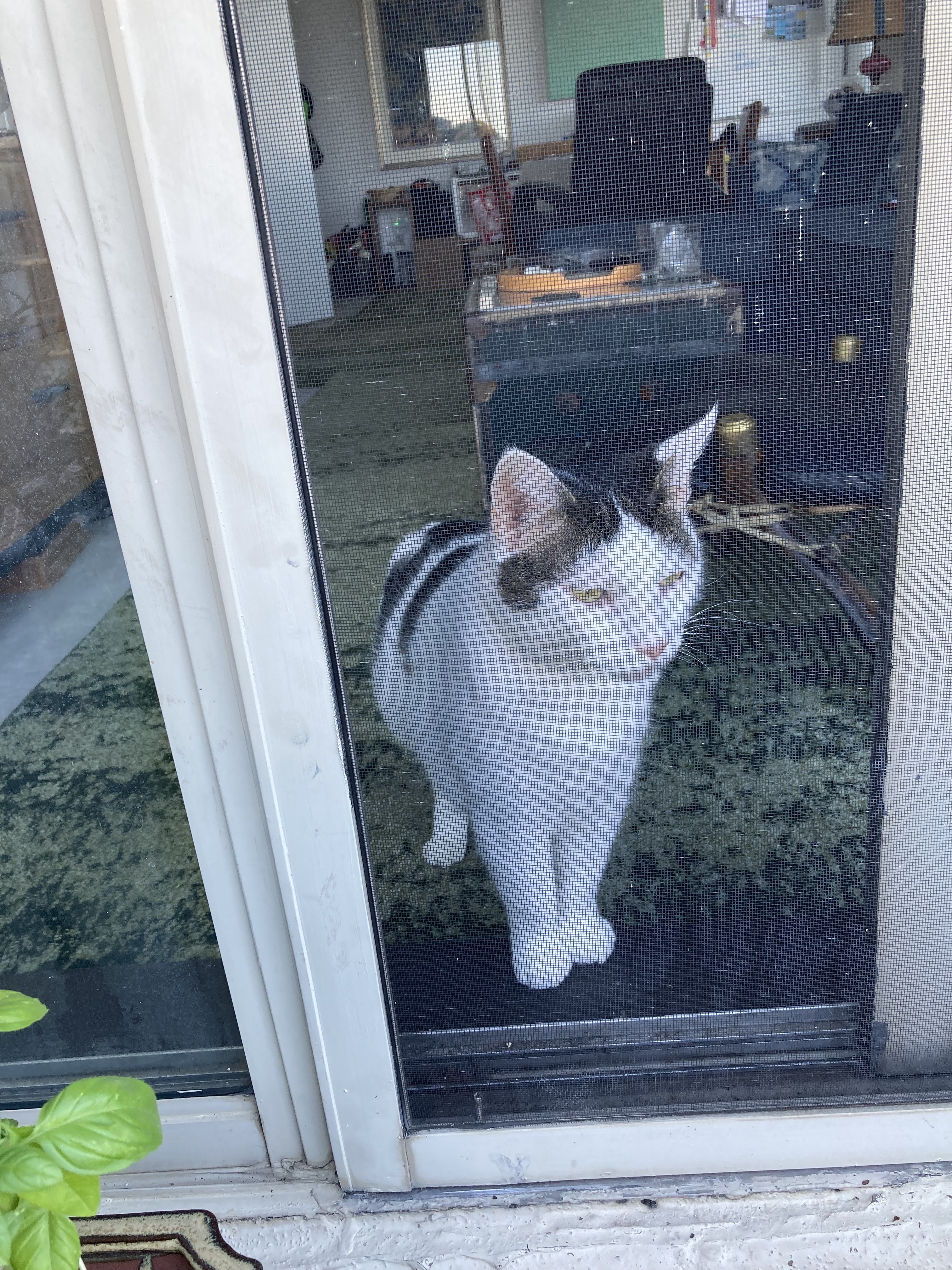
In closing, I'll give you a snapshot of Sal the Wonder Cat, just because.
Sal is also rooting for you, always, especially if you have kibble to share.