
Ooooh, my goodness. When my thick envelope arrived from Big Game Books, I had no idea what I was in for: 5 magnificent tinysides, the first in a cavalcade of a series from one Maureen Thorton, resident book-binder and awl-victim of Capitol Hill. They are handmade! They are 4-color gorgeous! They are only $4.50!
They are already sold out. Begin your envy.
"butterflies" by Jessica Smith (pictured above) has the most substance per square inch. Each poem sprawls and loops across the square pages. The immediacy of the butterflies in the natural landscape intersects with a hinted-at emotional landscape of the speaker, who revisits and reconnects wordings in gestures of reconciling the two. My eyes enjoyed roaming these poems.
Mark Lamoureux's "Acheron Census" features this lovely small lyric:
Jaffrey, NH
They walked there,
together,
from Noone Falls Mill.
#
Each of the short poems has the title of a town, tweaking the "Census" theme.
"The Archivist's Log of Interpersonal Experiments," by Stephanie Anderson, takes the prize for best cover (clean lines in pine green and ruddy orange), and consists of 26 four-line sections, interrogating actions described in the (alphabetically sequenced) titles: Handling the Juggler, Bickering with the Kiln-Stoker, Kissing the Literalist, Riding Sidecar with the Motorcyclist, etc.
In other news, the latest first-book interview at Kate Greenstreet's site is none other than...Frannie Lindsay. Worlds collide! Go check it out.
And, exactly one week from today I will be taking it off at Burlesque Poetry Hour.
Also, a trip to Baltimore left me obsessed with moving to Tindeco Wharf (waterfront, right between Fells Point and Canton). Anyone up there want to hire a poet? It's a restless time of year.
First off, a quick congratulations to Paul Guest, who just revealed that his book Notes for My Body Double has won the Prairie Schooner Prize. This puts him in an elusive club, joining my friend Frannie Lindsay, of poets who have had both their first and second books published via prestigious contest wins.
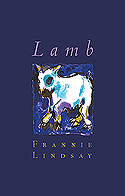 Frannie's first book, Where She Always Was, won the May Swenson Award; her second book, Lamb, is forthcoming as Perugia Press’s 2006 Intro Award winner. I'm a big fan of the cover, pictured here.
I've been thinking a lot about first books lately, when and how to take the plunge: it's an overlooked fact that the odds of someone's manuscript being ready for publication, and the readiness of that poet to be the author of his/her first book, are extremely unlikely to happen at the same time. I've been following Kate Greenstreet's terrific series of interviews with poets on how their first book did (or did not) change their lives.
One recurring theme in the Q&As is that the poets who made the happiest transition beyond initial publication were those who were already actively invested in another phase of writing when the first book finally made it into print. Which makes sense...except, in practice, until that earlier collection receives the outside validation, I suspect we continually ask ourselves: is this my real first book? Is this my new, better self? Shouldn't these shiny new poems squeeze out those dusty old ones? If I just shuffle and reshuffle and pay my $20 fees and hold out another 8 months, will Louise Gluck recognize my singular genius?
Just keep writing, I know. A friend was warning me, just the other day, to not throw the baby out with the bathwater just because I was excited with some new work. Then she admitted that she, too, was thinking about reincarnating her first book manuscript--allowing only a few core poems to survive from the previous version. Shut up. Keep writing. I know. I know.
Last night I was at a mothertongue reading at the Black Cat here in DC (yes, Tara Betts was *amazing*). A woman was preparing for her open mic stint by running her fingers over lines scribbled in a journal. The journal's cover was ornate, red leather molded with the Sacred Heart of Jesus (you know, the flaming one). "That's a nice journal; I bet that's from Florence," I said, and it was--a gift from the woman's friend. "But," the poet confessed, "I had it for months, and I never actually wrote in it. It's so fancy. It just didn't feel like...me. So now I use it for the dirty stuff." Sure enough, the poem she read from it was a sinuous erotic encounter--thumb licking, head turning, sighing and sweating. She had a little black notebook tucked in her jeans pocket for the more straightforward stuff.
I sympathize.  To give a journal to a writer is safe, like giving something adorned with an apple to a teacher. But really, we tend to be very picky about where we write and what we write in. I have stacks of untouched journals from well-meaning friends. I bet I'm not the only one.
Cornelius Eady finally convinced me to keep a notebook; for every previous professor I had just created a mock-journal at the last minute, scribbling out retroactive drafts from the poems I had created on a computer. The magic book, for me, had a hula girl on the front who danced when you shifted the cover in the light. Today, I can thumb back through it and see the antecedents of poems that have long since evolved into print. I love that. But sadly, I wrote out the last page a few months ago and have yet to find a suitable replacement. I'm looking for decent heft, a line wide enough and tall enough, a cover that is colorful but not distracting. There have been a few contenders but nothing quite right, and now there's growing pile of orphaned journals with just two pages used.
Too hot! Too cold! Where's the one that is just right?


